
The Sacred Cloth
Demystifying the college asset valuation process in the professional era
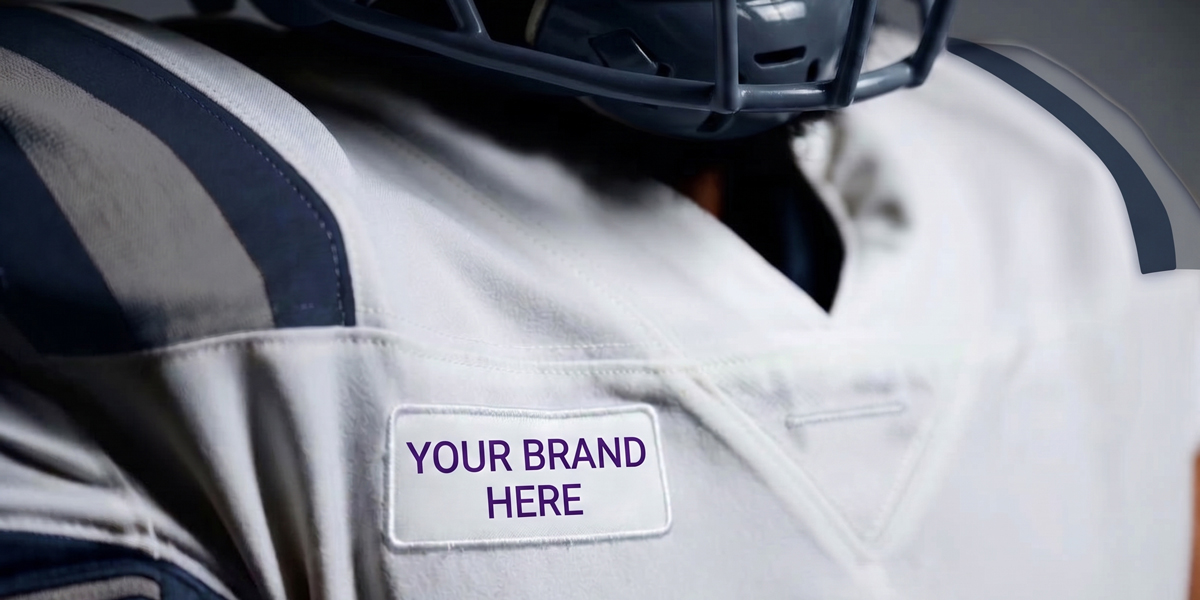
For decades, the collegiate athletic uniform was sacred ground. It was an untouched expanse of institutional color, devoid of the corporate intrusions that have long defined European soccer and, more recently, the NBA. But in the modern, rapidly professionalizing era of college sports—an era defined by multimillion-dollar revenue-sharing caps, massive legal settlements, and the ceaseless hunt for new capital—that sacred ground has been rezoned for commercial development.
The introduction of corporate sponsor patches on jerseys and branded logos painted directly onto the fields and courts represents a significant inventory unlock in sports business. It is a gold rush. But like many gold rushes, the initial frenzy has obscured a critical, structural flaw in the marketplace: the college sports industry is currently operating without a centralized compass for valuation.
When it comes to calculating the fair market value (FMV) of these premier sponsorship assets, college athletics desperately needs to abandon its reliance on comparative rumor and adopt a rigorously data-driven methodology. As it stands today, the market is being driven by vanity metrics, information asymmetry, and peer-to-peer panic—a dangerous cocktail that is actively stripping value from the very institutions desperate to capture it.
The Anatomy of a Valuation
To understand the dysfunction of the current market, we must first understand how fair market value should be calculated. In a rational economic ecosystem, the price of a jersey patch or an on-field logo is dictated by a specific, quantifiable set of market drivers.
The foundational metric is, of course, broadcast rights and linear television exposure. But visibility in college sports is remarkably dynamic. A football program that strings together two ten-win seasons will command a premium, but if that same team loses its head coach and stumbles to a 4-8 record, its national broadcast windows—and the corresponding corporate impressions—will plummet.
Beyond the volatility of television, true FMV requires an algorithmic blending of localized and digital metrics. What is the sustained, year-over-year game attendance? What is the engagement rate—not just the raw follower count—of the athletic department’s social media channels? What is the size, affluence, and geographic density of the university’s donor and alumni base?
Because these variables can fluctuate wildly from campus to campus, FMV is inherently idiosyncratic. A $3 million valuation for a jersey patch at a flagship state university in the SEC is driven by entirely different mechanics than a $3 million valuation at a similarly sized, academically equivalent institution in the Big Ten or the ACC. Even within the borders of the same state, the demographic profiles and alumni purchasing power of rival schools dictate completely divergent pricing models.
Yet, rather than doing the arduous mathematical work of understanding their own unique data profiles, many athletic directors are looking out their windows to see what their neighbors are doing.
The Vanity Pricing Trap
In a healthy marketplace, competitors have access to foundational fact bases—standardized benchmarks that allow buyers and sellers to negotiate in good faith. But college athletics is notoriously siloed. There is very little transparent communication or collaboration between rival athletic departments regarding commercial contracts. Nature abhors a vacuum, and in the absence of hard data, athletic directors fill the void with press releases.
This is where the market breaks down.
Imagine a scenario where University A proudly announces a groundbreaking, multiyear jersey patch partnership worth $3 million annually. University B, a fierce in-state rival, sees the headline. The athletic director at University B assumes that because they compete in the same conference and recruit the same athletes, their jersey patch must also be worth exactly $3 million.
What the press release obscures is the underlying financial architecture of the deal. In college sports, commercial sponsorships and philanthropic donations are frequently intertwined. It is possible that the brand sponsoring University A did not actually value the media impressions of the jersey patch at $3 million. Instead, a wealthy alumni CEO may have already earmarked $2.5 million as a philanthropic gift for a new weight room, and the athletic department bundled that donation with a $500,000 corporate sponsorship to create a splashy, headline-grabbing $3 million “partnership.”
By anchoring their own expectations to University A’s inflated, bundled vanity metric, the athletic director at University B has just anchored their department to a ghost.

The Cascade of Panic
This false equivalency sets off a destructive behavioral cycle. Armed with an artificially inflated sense of their own fair market value, University B enters the market demanding $3 million for their jersey patch.
Corporate brands and the sports marketing agencies that represent them are incredibly savvy. They possess the proprietary data, the media equivalency models, and the viewership metrics that athletic departments often lack. They know the true value of the asset. When a brand offers University B a data-backed, mathematically sound $1.5 million for the patch, the athletic director—fearing public embarrassment and believing they are being lowballed relative to their rival—rejects it out of hand.
But time is the ultimate leverage in sports business. Brands are perfectly willing to wait. They understand that as the lazy days of June turn into the frantic weeks of August, the leverage shifts.
As the season opener looms, the athletic director realizes the inventory is about to go unsold. The pressure to feed the impending $20.5 million House settlement revenue-sharing cap is suffocating. Panic sets in. In a desperate, 11th-hour scramble to secure any revenue at all, the department capitulates, accepting a fire-sale deal for pennies on the dollar.
This panic sale does more than just hurt the department’s bottom line for the current fiscal year; it fundamentally resets their baseline value in the eyes of the corporate world. Once an institution proves it will cave under pressure, it is incredibly difficult to ever command a premium price again.
This dynamic disproportionately threatens the “middle class” of college athletics. While the richest Power Four programs can occasionally absorb a commercial misstep through massive media rights payouts, less wealthy Power Four departments and Non-Power Four institutions are highly vulnerable. In their desperate attempt to keep pace with their wealthiest competitors, they are precariously positioned to overprice their assets based on rumor, hold out too long, and ultimately leave vital capital on the table.
The Premium of Patience and Fit
How does the industry correct this market failure? It begins by shifting the internal questioning. Rather than asking, “What did our rival get?” athletic directors must ask: “What are we uniquely trying to accomplish, and how does this asset help us accomplish it?”
“Do we want to sell it for 50 cents on the dollar just to get one or do we want to wait and make sure we get it right? Because once you take that price point, it’s hard to go back on that.” — Keith Carter, Ole Miss Athletic Director
Brands are not looking for a blank canvas to thoughtlessly slap a logo on; they are looking for comprehensive, integrated partnerships that drive measurable business outcomes. A brand that perfectly aligns with a university’s demographic will inherently extract—and thus, be willing to pay—more value for the asset.
Furthermore, schools must strategically manage the visual real estate of their athletes. While NCAA rules permit two patches during the regular season, departments would be wise to consider the psychology of packaging and “shared voice.” A uniform plastered with three disparate, mid-tier corporate logos looks like a minor-league hockey sweater. It dilutes the prestige of the university brand. Conversely, maintaining a clean aesthetic with one exclusive, premium patch signals exclusivity, driving up the asking price.
Liberation by Information
The commercialization of the collegiate uniform and playing surface is a permanent reality. But right now, we are witnessing a classic behavioral economics trap. As long as this nascent market operates on a foundation of comparative rumors, inflated press releases, and last-minute panic, athletic departments will continue to wildly misprice their most valuable real estate.
So, how do you solve a market failure driven by information asymmetry? You introduce an objective referee. This is exactly where multimedia rights (MMR) partners can—and must—step in to save universities from themselves. Think of an elite MMR agency not just as a sales broker, but as a strategic market-maker.
“We do not just broker deals. By managing the commercial inventory for dozens of university partners, we’ve established the baseline metrics required to see exactly what an asset is worth. We provide empirical data so our partners never have to negotiate based on panic or peer pressure.” — Christy Hedgpeth, President, Playfly Sports Properties
Ultimately, the programs that thrive in this new economic era will be those that quiet the external noise. By relying on the empirical reality provided by their multimedia partners and demonstrating the discipline to wait for the right synergistic fit, universities can stop settling for panic-induced pennies on the dollar. They can finally capture the true, calculable commercial worth of their brands.